
Buddhist Tools for the In-Between
On impermanence, detachment, and learning to loosen your grip on what was never meant to stay

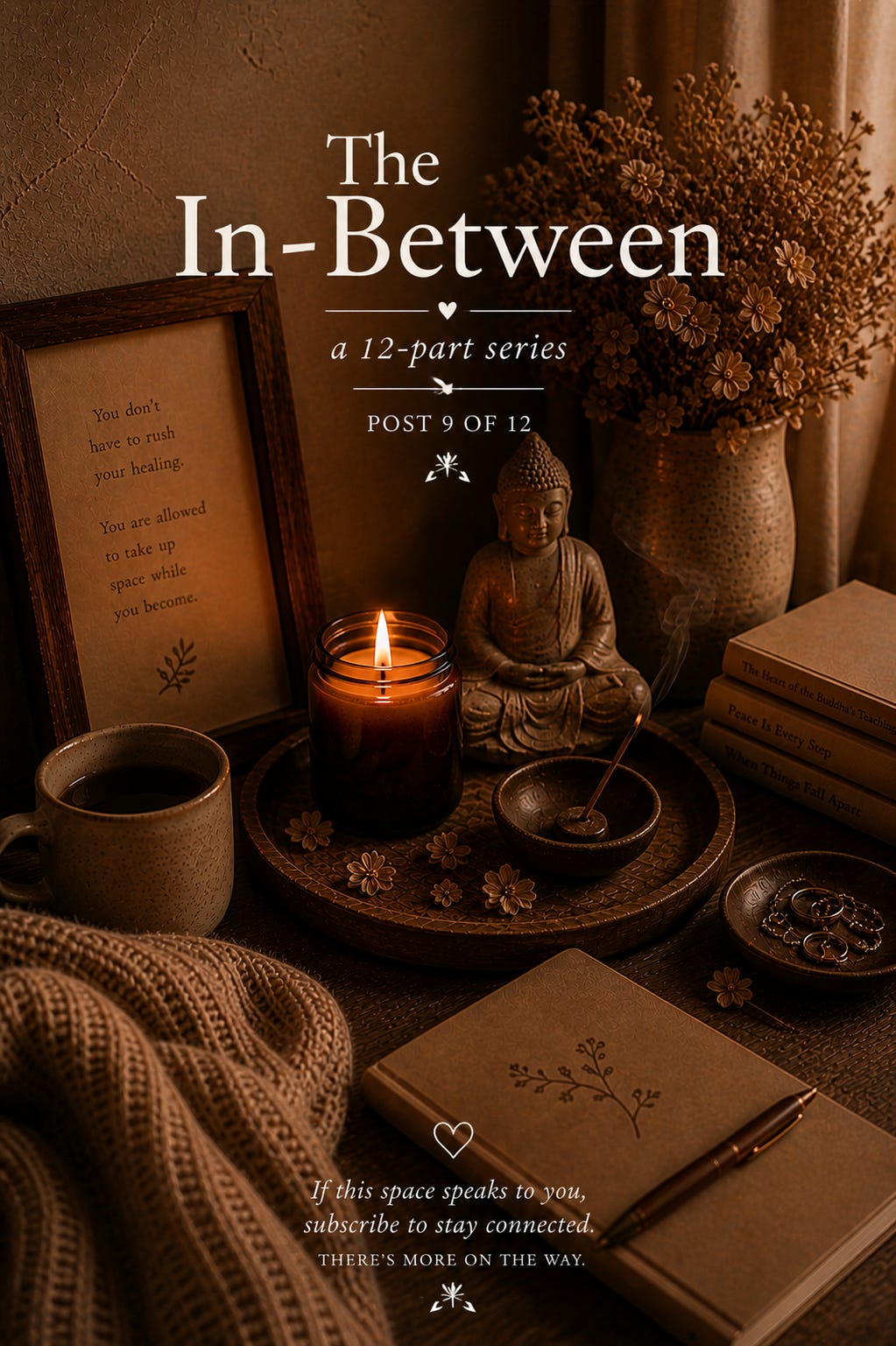
There is a teaching that changed the way I understood my own suffering.
Not a technique. Not a practice. A single, simple truth that Buddhism has been pointing toward for centuries — that suffering comes not from what happens to us but from our relationship to it. From the clinging. From the resistance. From the reaching toward what isn’t here yet and the gripping of what is already leaving.
That teaching found me at the right time. Which is to say it found me here, in the liminal space, where clinging and resistance are the two most natural responses to everything.
Because the in-between asks something of you that nothing in survival mode prepared you for. It asks you to stop gripping. To let the old identity dissolve without chasing it. To let the new one form without forcing it. To exist in the middle without demanding that the middle resolve itself on your timeline.
That is not a small ask. For someone whose nervous system learned that control was safety, that doing was surviving, that stillness was danger — releasing the grip feels like falling. Even when what you’re releasing was never truly yours to hold forever.
I’ve been learning this most concretely around money.
For a long time my worth and my output were the same thing. The hustle wasn’t ambition — I understand that now. It was survival dressed up as productivity. A conditioned belief that value has to be earned through effort, that rest is something you negotiate with guilt, that slowing down is something you justify rather than something you simply choose. I worked not from desire but from necessity. And after long enough, necessity becomes identity. You forget there was ever another way to be.
Stepping back from that in this season — intentionally choosing rest, releasing the extra work, letting burnout finally tell its truth — has required a detachment practice I didn’t know I needed until I was inside it.
Detachment in the Buddhist sense is not distance. It is not indifference. It is not pretending something doesn’t matter. It is the practice of holding what is here without gripping it. Letting it be present without demanding it stay or go on your terms. Meeting what is without the story about what it should be.
That distinction matters because I spent a long time confusing detachment with numbness. Thinking that not feeling was the same as not suffering. But numbness is just another form of control. Real detachment is feeling everything and still not letting the feeling make your decisions for you.
The practice of noting — a simple Buddhist mindfulness tool where you silently name what is arising without following it — has been one of the most grounding things I’ve found in this season. Restlessness. Resistance. Grief. Craving. Just the word, placed gently on top of the experience, without analysis, without judgment, without the need to fix or explain. The naming creates just enough distance between you and the feeling that you remember you are not the feeling. You are the one noticing it.
And then there is impermanence. The teaching I return to most.
Nothing is fixed. Not the wound. Not the confusion. Not the liminal space itself. Not the version of you that survived by gripping everything tightly. Not even the becoming — which feels so uncertain right now but is also, in its own way, already moving. Everything that feels permanent is in motion. Everything that feels like it will last forever is already changing.
That is not a cold truth. In the right season it is one of the most freeing things you can hold.
The hustle felt permanent because survival always does. The conditioned worth felt permanent because it was there before you had language for it. But it was always a season. And this is a different season. And this season too will move.
What the Buddhist tools have given me in the in-between is not resolution. They don’t promise that. They give you a different relationship to the unresolved. A way to sit inside the not knowing without it becoming unbearable. A practice of releasing the grip, again and again, not because you’ve mastered it but because you keep choosing it.
That choosing is the practice. That is all it ever is.
If you are in the in-between and you are suffering from your own clinging — clinging to who you were, clinging to certainty, clinging to a version of productivity or worth or love that the season is asking you to release — I want to offer you this gently.
You don’t have to hold it so tightly.
Not because it doesn’t matter. But because impermanence was always true. And what is meant to remain will remain even when you loosen your grip. And what dissolves in the loosening was never yours to carry this far anyway.
The liminal space is impermanent too. You don’t have to hold it forever. It is already moving even when it doesn’t feel like it. Everything that is meant to remain will remain. Everything else is already loosening its grip. Let it.
I’m not here to package healing into something pretty.
I’m here to tell the truth about it.
If you’re done pretending you’re okay just because you look like it…
subscribe.